
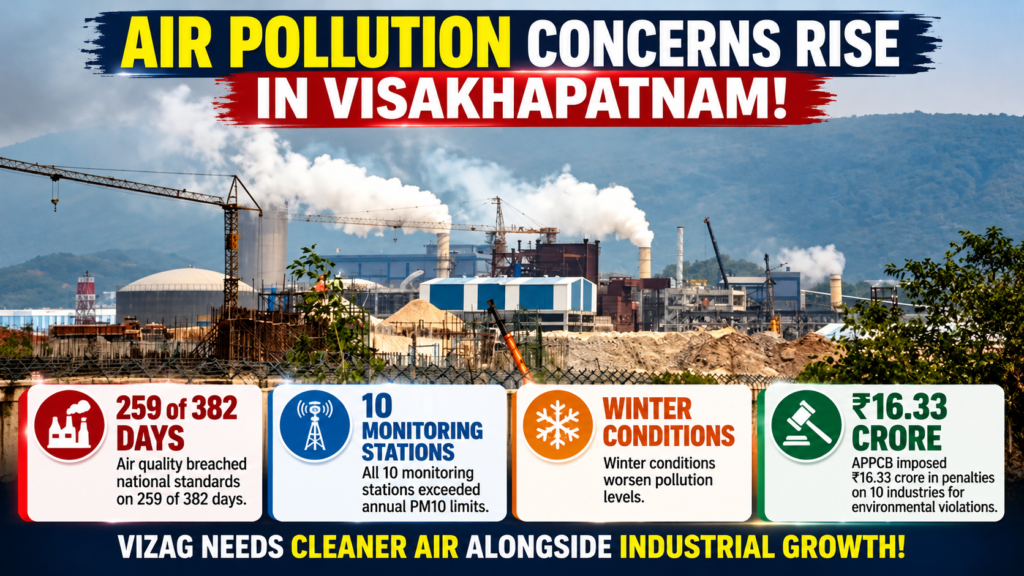
Visakhapatnam faced frequent air-quality concerns between September 2025 and September 2026, with the AQI exceeding 100 on 259 of 382 days with available readings. All 10 monitoring stations recorded annual average PM10 concentrations above the national standard, while APPCB imposed approximately ₹16.33 crore in environmental compensation on 10 industries.
Air Pollution in Visakhapatnam: AQI Exceeded 100 on 259 Days
Visakhapatnam: Air pollution remains a concern in Visakhapatnam, with monitoring data indicating frequent breaches of air-quality benchmarks and elevated particulate matter levels across the city.
According to a report published in October 2026, Visakhapatnam’s Air Quality Index (AQI) exceeded 100 on 259 of the 382 days for which readings were available between September 2025 and September 2026. All 10 monitoring stations also recorded annual PM10 averages above the national standard, highlighting the continuing challenge of controlling dust and industrial emissions.
PM10 Levels Above the National Standard at All 10 Stations
The reported 12-month average PM10 concentrations across the 10 monitoring stations ranged from 84 to 135 micrograms per cubic metre (µg/m³), against the annual national standard of 60 µg/m³.
PM10 refers to airborne particles measuring 10 micrometres or less. These particles can come from road dust, construction, industrial activity and other sources.
The reported figures indicate that particulate pollution is not confined to a single monitoring location. However, pollution levels vary by station and over time, making continued monitoring and source-specific action important.
Winter Conditions Linked to a Sharp Rise in Pollution
December 2025 recorded a marked deterioration in air quality. Of the 30 daily AQI readings reported for that month, 25 fell in the “poor” or “very poor” categories, and none were classified as “good” or “satisfactory”.
The average daily AQI for December was reported at 255, compared with 88 in October 2025.
Seasonal weather conditions can influence how pollutants disperse, while emissions from traffic, road dust and industrial activity can add to the pollution burden. The reported data show a significant winter spike, although the contribution of individual sources requires further assessment.
APPCB Imposes ₹16.33 Crore in Environmental Compensation
The Andhra Pradesh Pollution Control Board (APPCB) has imposed environmental compensation totalling ₹16,32,75,000—approximately ₹16.33 crore—on 10 industries in the Visakhapatnam area for violations of environmental norms and pollution-control standards, according to published reporting.
The action followed monitoring and inspections that identified non-compliance at industrial units. The board had earlier directed industries to meet emission standards and ensure that pollution-control equipment was properly operated and maintained.
Environmental compensation is an enforcement measure. Its impact will depend in part on compliance with corrective directions and sustained improvements in emissions and ambient air quality.
Cleaner Air Remains a Challenge for an Industrial City
Visakhapatnam is an important industrial, port and urban centre. Managing air pollution requires attention to multiple potential sources, including industrial emissions, vehicle exhaust, road dust and construction-related particles.
The reported monitoring figures point to the need for continued enforcement, reliable monitoring stations, dust-control measures and transparent public reporting of air-quality trends.
For residents, checking current AQI readings and following local health advisories can help inform decisions during periods of poor air quality.
Vizag TV will continue to follow developments in air quality and environmental enforcement across Visakhapatnam.
Source note: Figures and enforcement details are based on published reporting dated October 2026. The monitoring period and the distinction between AQI readings and pollutant concentration standards are retained to avoid treating them as the same measure.
FAQs
1. How often did Vizag’s AQI exceed 100?
The reported data recorded AQI readings above 100 on 259 of 382 days between September 2025 and September 2026.
2. What is the annual national standard for PM10?
The annual standard cited in the report is 60 µg/m³.
3. Which monitoring stations recorded elevated PM10 levels?
All 10 stations included in the reported analysis recorded annual average PM10 levels above the standard.
4. How much environmental compensation did APPCB impose?
Approximately ₹16.33 crore on 10 industries for environmental and pollution-control violations.
5. Why can air pollution worsen in winter?
Weather conditions can reduce the dispersion of pollutants, allowing emissions and airborne particles to accumulate. The degree of impact varies with local conditions and emission sources.


