
The Andhra Pradesh Government is planning a ₹1,000 crore drinking water project for Visakhapatnam to ensure long-term water security. The project proposes bringing Godavari water through the Polavaram Left Main Canal to KBR, Meghadrigedda, and a new treatment plant at Mudasarlova. Additionally, a ₹570 crore drinking water network for Madhurawada, ₹110 crore SCADA system, and ₹1,500 crore sewage treatment project are also planned to improve water management across the city.
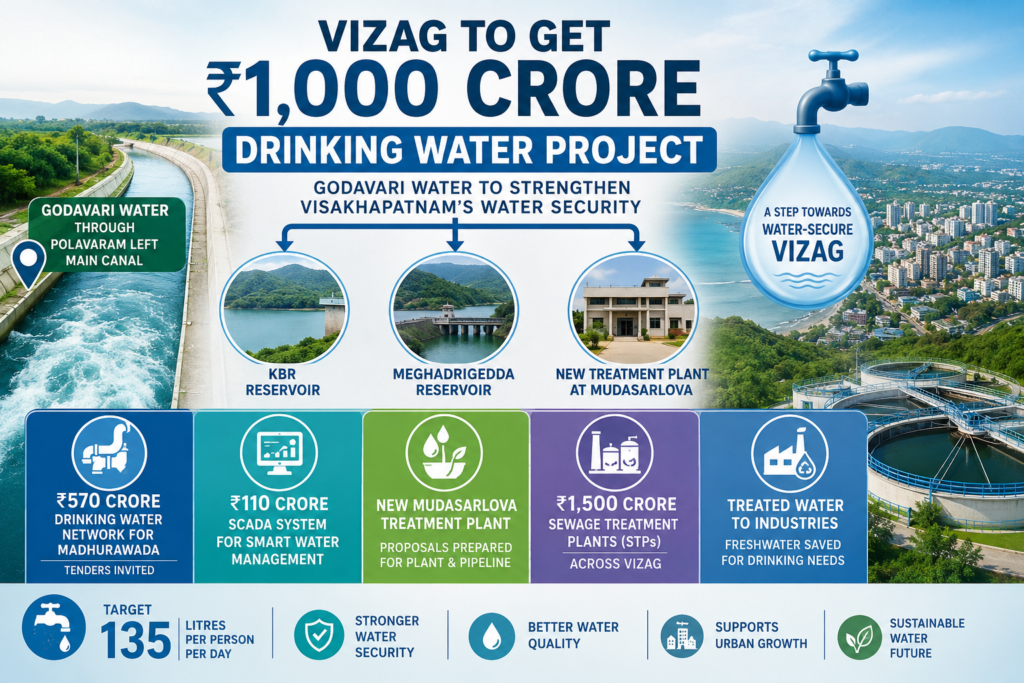
Vizag to Get ₹1,000 Crore Drinking Water Project; Godavari Water to Reach City
The Vizag Drinking Water Project is set to become one of the biggest water infrastructure initiatives planned by the Andhra Pradesh Government. To meet the growing demand for drinking water in Visakhapatnam, the government is preparing a ₹1,000 crore project that will bring Godavari River water through the Polavaram Left Main Canal.
The proposal aims to strengthen the city’s drinking water infrastructure and provide a sustainable water source for future generations.
Godavari Water to Reach Major Reservoirs
Under the proposed project, water from the Polavaram Left Main Canal will be supplied to:
- Kambalakonda Balancing Reservoir (KBR)
- Meghadrigedda Reservoir
- New Water Treatment Plant at Mudasarlova
The project will improve the city’s storage capacity and ensure uninterrupted drinking water supply across several parts of Visakhapatnam.
₹570 Crore Madhurawada Drinking Water Network
Apart from the main project, the government has already floated tenders worth ₹570 crore for a modern drinking water distribution network in Madhurawada, one of Vizag’s fastest-growing residential zones.
The project includes:
- New underground pipelines
- Distribution network expansion
- Better water connectivity for new layouts
- Future-ready infrastructure
₹110 Crore SCADA System
To modernize water management, the government is also planning a ₹110 crore SCADA (Supervisory Control and Data Acquisition) system.
The SCADA system will help authorities:
- Monitor water supply in real time
- Detect leakages quickly
- Improve operational efficiency
- Reduce water loss
- Manage reservoirs digitally
New Mudasarlova Water Treatment Plant
Officials are preparing proposals for a new water treatment plant at Mudasarlova, along with transmission pipelines connecting major reservoirs.
Once completed, the project will significantly increase Visakhapatnam’s water treatment capacity and support the city’s future expansion.
₹1,500 Crore Sewage Treatment Plants
The Andhra Pradesh Government is also planning ₹1,500 crore worth of Sewage Treatment Plants (STPs) across Visakhapatnam.
The treated wastewater will be supplied to industries, reducing their dependence on freshwater. This will allow more freshwater to be reserved exclusively for drinking purposes.
The initiative aims to ensure 135 litres of drinking water per person per day (LPCD), improving the overall quality of urban water supply.
Benefits of the Project
Once implemented, the project will:
- Strengthen Vizag’s water security
- Reduce future water shortages
- Bring Godavari water to the city
- Improve water quality
- Supply treated water to industries
- Save freshwater for households
- Modernize water distribution using SCADA
- Support Vizag’s rapid urban growth
Follow @vizag_tv on Instagram for the latest updates on Vizag infrastructure, AP Government projects, city development and breaking news.
Frequently Asked Questions
What is the cost of the Vizag Drinking Water Project?
The Andhra Pradesh Government is planning a ₹1,000 crore drinking water project for Visakhapatnam.
Where will Vizag get drinking water from?
The project proposes bringing Godavari River water through the Polavaram Left Main Canal to Visakhapatnam.
What is the Madhurawada water project?
It is a ₹570 crore drinking water distribution network planned for Madhurawada.
What is SCADA in the water supply project?
SCADA is a digital monitoring system used to manage reservoirs, pipelines, and water distribution efficiently.
Why are Sewage Treatment Plants being built?
The STPs will supply treated wastewater to industries, allowing freshwater to be reserved for drinking purposes.